
Why Integrated Illumination And Laser Autofocus Matter In High-Throughput Imaging | Melles Griot Advantage (Part 5)
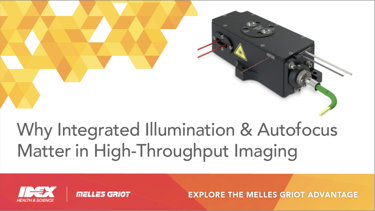
Faster imaging is pushing OEM developers in machine vision, semiconductor inspection, digital pathology, and automated microscopy to acquire more data without giving up image quality or reliability. A better camera or a brighter light source rarely settles it. Throughput is described as a system-level problem, and optimizing one subsystem in isolation can create a bottleneck elsewhere.
Focus is where the tension shows most clearly. As imaging speeds rise, maintaining focus gets harder, particularly when sample tilt, fast stage motion, and mechanical or thermal variation come into play. Image-based methods and laser-based methods handle that pressure differently. Questions about autofocus architecture, and about developing subsystems together rather than independently, bear on development schedules and implementation risk.
James Letterneau, Sr. Engineering Manager at IDEX Health & Science, offers an engineer's view of why aligning independently developed subsystems at the top level is so difficult. Get the full article for the systems-level argument.
Get unlimited access to:


Enter your credentials below to log in. Not yet a member of Photonics Online? Subscribe today.