
Seeing In Space: A Primer On Photodetection For Astronomy And Space Science
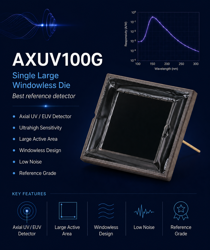
Explore an introductory guide for engineers new to space photonics, covering the spectral bands accessible on orbit and the detector technologies that access them.
The framing rests on two ideas. First, most astronomical information lies outside the visible band—X-ray, ultraviolet, infrared, and radio each reveal a distinct physical mechanism, from black holes and neutron stars at the high-energy end to cold hydrogen and the cosmic microwave background at the low-energy end, so selecting a science target effectively means selecting a spectral band and, with it, a detector family. Second, not every space detector forms an image: a large share of instruments are small, calibrated photodiodes that report incident flux within a defined band and hold that response without drift across a mission's lifetime, distinguishing measurement and calibration tasks from imaging tasks that call for arrays like CCD, CMOS, or cooled HgCdTe.
The content surveys detector technologies by spectral reach and role (silicon, AXUV/SXUV silicon, InGaAs, HgCdTe, microchannel plates), the environmental stressors that degrade detectors on orbit (radiation, UV/EUV exposure, thermal cycling, vacuum and outgassing) and how each is mitigated, and a table mapping instrument roles—Sun sensors, solar EUV/X-ray monitors, radiometric references, particle flux detectors, beam monitors—to detector approaches.
It closes by positioning stable, radiation-tolerant silicon photodiodes as reference and monitoring detectors that keep larger instruments calibrated over years on orbit, with contact information for an applications engineering team.
Get unlimited access to:




Enter your credentials below to log in. Not yet a member of Photonics Online? Subscribe today.