
Fluorescence Detection In Veterinary Diagnostic Instruments
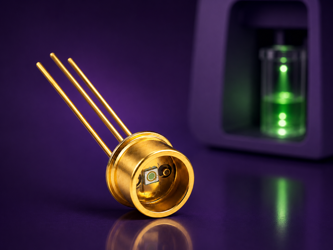
This application note addresses a core engineering challenge in point-of-care veterinary analyzers: detecting a faint, Stokes-shifted fluorescent emission against a much brighter excitation source, while maintaining stable readings over years of clinic use.
The central design principle is to match the detector to the fluorophore's emission band rather than the excitation wavelength. Fluorescein-style green labels emit near 520 nm, rare-earth time-resolved labels near 615 nm, and near-infrared dyes past 650 nm—so blue- and red-enhanced silicon photodiodes, tuned to these specific bands, outperform flat general-purpose diodes. The second variable is photon budget: bright lateral-flow or microsphere assays work well with low-dark-current silicon PIN photodiodes, while photon-starved assays (low-titer infectious disease panels, single-cell cytometry) benefit from a silicon avalanche photodiode's internal gain, which lifts weak signals above the noise floor without the bulk of a photomultiplier tube.
The content walks through a practical selection framework, a comparison table of generic versus field-engineered detectors, common failure modes (excitation breakthrough, dark-current drift, weak-label misses, channel mismatch) and their design responses, and a product table mapping six detector/emitter families—Blue Enhanced Si, Red Enhanced Si, Standard Silicon, Silicon APD, InGaAs, and Red/IR LED emitters—to specific veterinary applications like FIA readers, lateral-flow analyzers, and hematology/cytometry instruments.
It closes with custom engineering program details (8–12 week qualification lead times, ISO 9001:2015 certification) and contact information for the applications engineering team.
Get unlimited access to:




Enter your credentials below to log in. Not yet a member of Photonics Online? Subscribe today.