
Benefits Of Beam Shaping: Overcoming The Speed vs. Sensitivity Trade-off
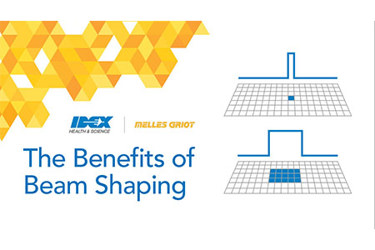
Fluorescence imaging systems have long forced designers to compromise between sensitivity and throughput. Small, high-intensity beams deliver excellent signal quality but require slow, step-by-step scanning, while larger beams increase imaging speed at the expense of power density and excitation efficiency. Compounding the challenge, Gaussian beam profiles create uneven illumination that can reduce image quality and limit system performance.
This article explores why traditional illumination approaches—including Powell lenses and diffractive optics—often fall short in commercial instruments. While these technologies can improve beam shaping, they introduce challenges such as extreme alignment sensitivity, wavelength dependence, reduced efficiency, and compatibility limitations that restrict design flexibility.
Learn how the Widefield Illumination Module from IDEX Health & Science addresses these longstanding obstacles with a source-agnostic approach that supports both lasers and LEDs. The platform combines multiple excitation wavelengths into a single compact module while producing a highly uniform top-hat illumination profile with minimal spatial variation, even from distorted or non-uniform input beams.
The article also highlights key performance advantages, including greater than 80% optical efficiency, support for up to five integrated wavelengths, and customizable square or rectangular beam geometries across a wide range of fields of view. These capabilities enable designers to improve imaging speed without sacrificing sensitivity or uniformity while reducing the complexity associated with traditional beam-shaping methods.
For engineers developing next-generation fluorescence instruments, the result is a more flexible illumination solution that helps maximize throughput, improve data quality, and simplify optical system design.
Get unlimited access to:




Enter your credentials below to log in. Not yet a member of Photonics Online? Subscribe today.