
Temporal Filtering Technique Improves Solid-State Single Photon Sources
An international collaboration led by researchers from the
Solid-state quantum emitters like quantum dots have great potential to serve as bright, stable single photon sources that can be readily incorporated into systems that can be manufactured with scalable fabrication methods. However, interactions between a quantum emitter and its surrounding environment often lead to non-ideal emission. In particular, events where more than one photon is emitted at a time or where photon waveforms are non-identical are common occurrences that reduce the usefulness of these sources. Previous research has sought to overcome these obstacles by nanofabricating device geometries that make the timescale for photon emission shorter than the time over which environmental influences cause photons to become non-identical because phase information is degraded. The CNST-led team has now demonstrated a fundamentally different approach – rather than influencing the emission process, they manipulate the emitted light after it has been generated.
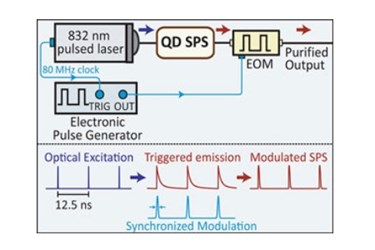
In the new technique, photons emitted from a fiber-coupled, quantum dot single photon source are directed into a commercial electro-optic modulator that acts as a temporal gate, transmitting light only at specified times and intervals. The periodically pulsed laser that excites the quantum dot also sets the timing for when the modulator is opened. The team found that by optimizing the duration over which the modulator is opened, they could improve single photon purity, rejecting the emission of photons that occur either at different times or at time-scales other than that desired for single photon emission. Furthermore, photons can be made identical to each other by allowing only the portion of the photon waveforms that are in phase with each other to be transmitted.
This temporal filtering approach is very general because it does not depend on the specifics of the source’s device geometry, excitation scheme, or materials. Future work will focus on using this technique to deliver improved source performance in applications.
Source: NIST