
Semrock Announces Ultrawide-Passband With Deep-Notch Thin-Film Filters
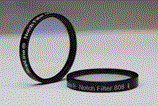
Rochester — Semrock Inc., a leader in optical filters for biotech and analytical instrumentation, has announced a breakthrough invention in thin-film optical filters: ultrawide-passband yet deep thin-film notch filters. These new notch filters achieve the deep (optical density > 6) laser-line blocking of Semrock's renowned StopLine® notch filters, yet with low-ripple passbands that now extend from the ultraviolet (350 nm) well into the near-infrared (1600 nm). These new "E-grade" StopLine filters are in stock and immediately available for the most popular laser wavelengths, including 488, 532, 561, and 808 nm, with more coming.
"Thin-film notch filters are the ideal solution for applications that require nearly complete rejection of a laser line while passing as much non-laser light as possible," explained Dr. Turan Erdogan, Semrock's CTO. "In addition to exceptional transmission with deep and narrow laser line blocking, modern multilayer thin-film notch filters offer an environmentally stable, optically durable and compact solution for today's laser-based optical systems. However, until now even the best thin-film notch filters either had a limited range of transmission due to the higher harmonics of the main reflection band , or a relatively limited attenuation at the laser wavelength. When a wider passband was needed, optical engineers had to turn to less reliable, less convenient and costlier holographic notch filters, or to Rugate notch filters with lower laser-line attenuation. Now Semrock's unique (patent pending) new E-grade StopLine filters bring together wide passband performance with all the advantages of deep-notch thin-film filters."
These new wide-passband notch filters are intended for any application requiring high rejection of one or more laser lines, while transmitting signal light over a wide range of wavelengths on either side of the laser wavelength. They are especially suited for systems addressing multiple regions of the optical spectrum (e.g., ultraviolet, visible, and near-infrared), and for systems based on multiple detection modes (e.g., fluorescence, Raman spectroscopy, laser-induced breakdown spectroscopy, etc.).
SOURCE: Semrock