
Newest In CT Imaging Technology — Dual Energy Source — Now Being Utilized On Patients At Penn
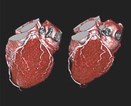
Benefits include: No medication, less radiation, faster imaging time
 Philadelphia, PA — The Hospital of the University of Pennsylvania (HUP) is now offering the newest multi-slice computed tomography (CT) imaging technology to patients, becoming the first hospital in Philadelphia equipped with pioneering dual x-ray source technology — which produces amazingly detailed 3-D images of the heart.
"This new technology provides us with faster, sharper images of the heart, helping doctors better diagnose potential blockages which could lead to heart attacks," explains Harold Litt, MD, PhD, Chief of Cardiovascular Imaging in Radiology at HUP. "Specifically, it allows us to take a picture of the heart twice as fast as the old 64-slice CT technology — at 83 milliseconds versus the old 165 milliseconds — with twice the imaging power. Since the heart is constantly beating and moving, the ability to 'freeze' that motion is essential to capture high quality images of the coronary arteries."
Another breakthrough benefit to this new imaging technology is that, for the first time ever, it is possible to examine every patient regardless of heart rate. Litt states that because of this faster "shutter speed," it is no longer necessary to try to slow down rapid heart rates in patients, via medication, before imaging their heart — saving vital time for some problematic patients.
"This new system also has a roomier bore to accommodate larger or claustrophobic patients. Plus, the new system exposes patients to as much as 50% less radiation dose because it obtains images in half the time," adds Litt.
The official name of the new system — which was delivered to HUP at the end of October and is now fully operational and being utilized on patients — is Siemens' SOMATOM® Definition. It is the world's first dual-source computed tomography system. What makes this system so cutting-edge is its use of two different X-ray energy sources (which can be used at two different X-ray energy levels) for two detectors. The interaction between the two with tissues in the body is different and by comparing those differences in the two images, radiologists can differentiate, characterize, isolate and distinguish body tissues and fluid, leading to breakthroughs in medical imaging. In the old 64-slice CT technology, only one X-ray energy source and one X-ray detector could be utilized at one time. Now, radiologists can run the 'dual energy' system simultaneously, allowing them to better freeze the motion of the heart and obtain diverse information about the anatomy in a single scan.
Radiologists utilize these images to search for narrowing or blockages in the coronary arteries of the heart. Litt continues, "We can use these images to figure out the cause when patients are complaining of chest pain. Specifically, we may be able to characterize different types of atherosclerotic plaque, including whether a patient has any of the type more likely to rupture and cause a heart attack."
Nick Bryan, MD, PhD, Chair of Radiology at Penn, comments, "It's interesting to note that some of the initial dual energy CT experimental development work was actually done here at HUP in collaboration with Siemens, the maker of the system, by Penn Radiology's Dr. Peter Joseph, back in the 1970s. Also, in recent years, some of the proof of principle research done specifically on this new dual energy approach was conducted here at HUP in a collaboration between Dr. Litt and a Siemens scientist."
Bryan adds, "When a patient comes to Penn, they can be assured that our team of radiologists and cardiologists are armed with the scientific expertise and clinical knowledge which will result in the best use of this new dual energy technology for excellent cardiovascular diagnosis and care."
SOURCE: University of Pennsylvania School of Medicine