
New Setup For Hybrid Photoacoustic And Ultrasound Imaging With Optical Ultrasound Detection
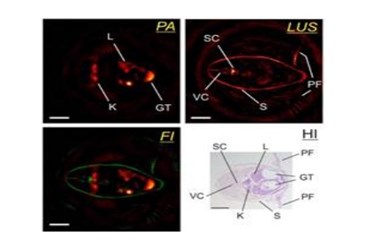
Photoacoustic (PA) imaging is a method to visualize structures with optical contrast in biological tissue. Despite the strong optical scattering in tissue, high resolution images in the visible and near infrared spectral range can be obtained. The method is based on sound waves which are generated in regions of enhanced optical absorption. The absorption of diffusely propagating optical radiation leads to a temperature rise and thermoelastic expansion causing sound waves which can be detected at the tissue surface. The strength of photoacoustic techniques is the imaging of the vasculature and the ability to derive functional properties such as oxygen saturation from signals detected at different optical excitation wavelengths.
However, anatomic details without optical contrast cannot be imaged. Hybrid devices, combining PA with ultrasound (
Focusing into a selected plane is achieved by concentrating the acoustic waves coming from the object with a concave cylindrical acoustical mirror onto an optical detector, which is a light beam in an optical interferometer. For the
Generation of focused ultrasound pulses with high bandwidth and detection of acoustical signals from a selected slice are made possible by a single element, a concave cylindrical lens coated with a light absorbing metal layer. This makes the device a cost-effective alternative to large scale array tomographs in cases where the region of interest can be covered by a low number of section images and where an imaging time of several seconds per slice is tolerable.
Source: Universities of Graz and Innsbruck