
Near-IR Instrument Monitors Product Quality in Real Time
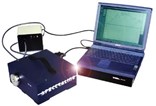
The consistency of a liquid product, such as gasoline or milk, is usually tested for quality by taking random samples from the production line to the laboratory and analyzing them using benchtop instruments. But the new instrument, dubbed ES 100, is said by its manufacturer to be the first spectrometer operating in the mid-IR region designed specifically to monitor products in real time as they flow through the manufacturing process.
"Our technology reduces unnecessary waste," says Rony Joseph, Spectraline's vice president of product development, in a Purdue press release. "By continuously monitoring the liquid flow with our spectrometer, operators can immediately revise the process the moment something fails to meet specifications rather than waiting until an entire batch has been ruined."
Although there are other spectrometers that work in the mid-IR region, they are relatively slow. While available instruments can complete a scan in one second, Spectraline says that its unit can take 390 complete scans in the same amount of time, enabling it to capture rapidly changing phenomena. A high-speed scan also enables large numbers of samples to be collected, which then can be averaged together to reduce "noise" or other conditions that might interfere with readings.
Previously developed mid-IR spectrometers are delicate instruments that rely on high-precision mechanisms for moving mirrors and gratings within the instrument. They are designed for use in the lab, not for rugged on-line applications, Joseph says. In addition, their lifetimes are limited to about 10,000 hours because they use cryogenic coolers, which also have many moving parts.
The shoe box-sized ES 100 instrument, however, can withstand being moved around the factory floor, says Spectraline, because it has no moving optical components. The unit also features a photosensitive detector made of lead selenide that uses a much less expensive cooling system and has a reported lifetime of more than 100,000 hours.
On top of shortcomings with durability and speed, most near-IR spectrometers lie idle for much of the time because of the extensive calibration required to block out background influences such as sunlight, room light, and heating sources. But Spectraline asserts that users need not perform any calibrations with its instrument, which can be deployed straight out of the box.

The ES 100 near-infrared spectrometer is some 390 times faster than conventional units, says its manufacturer. (Source: Spectraline Inc.)
The ES 100 can be used in three modes: emission mode, to study turbulent flames, monitor gas turbine combustors and utility furnaces; absorption mode, to monitor multiple constituents in flowing liquids; and reflectance mode, to monitor solids and powders. These methods can be used to measure fat in milk, sulfur in gasoline, and glucose in blood; to detect the presence of poisonous gases; to monitor a gas turbine or an engine to find out how lean it is running; or to monitor the spoilage of fruits and bacteria in meats and other foods.
Spectraline licensed the technology for the ES 100 from En'Urga Inc., which was founded in 1994 by Yudaya Sivathanu, a research scientist in Purdue's School of Mechanical Engineering. En'Urga formed Spectraline in 1999 to develop the instrument further for commercial applications.
For more information, contact Rony Joseph of Spectraline Inc. at 888-884-8236 or joseph@spectraline.com. Or contact Jeanine Smith of Purdue University at 765-496-3133 or jsmith@uns.purdue.edu.