
LIGO Hunts the Elusive Graviton
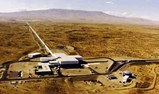
In a project designed to detect evidence of gravity waves from space, researchers are building interferometers with kilometers-long arms at Hanford, WA and Livingston, LA (see Figure 1). The Laser Interferometer Gravitational-Wave Observatory (LIGO) will consist of these two installations operated in unison as a single observatory. At a cost of almost $300 million, LIGO is the largest single enterprise ever undertaken by the National Science Foundation.

Figure 1: The 4-km-long arms of the interferometer at LIGO's Hanford, WA site stretch into the distance. When operational, the interferometer will detect movement in small masses caused by passing gravity waves. (Courtesy of LIGO Laboratory)
What it will do
Albert Einstein predicted the existence of gravitational waves as part of his theory of general relativity. In this theory, gravity is a manifestation of the curvature of space-time. Gravitational waves are roughly analogous to electromagnetic waves: created by accelerating masses, they can be described as ripples in the fabric of time and space.
Scientists have not yet been able to detect gravitational waves directly, only to measure their effects in other ways, such as in the movements of binary neutron stars. By measuring rapidly changing gravity, LIGO will test general relativity's prediction that these waves propagate at the same speed as light, and that the graviton (gravity's fundamental particle) has zero rest mass and twice the spin of the photon.
System design
The two facilities include L-shaped vacuum systems with arms 4 km. Laser-based Michelson interferometers housed in the tubes will sense gravitational waves from objects in space by detecting the minute, graviton- induced motion of test masses that are exquisitely isolated from sources of noise. By correlating data from the two widely separated sites, researchers will be able to identify gravitational waves and extract information about them. As other gravitation-wave detectors around the world are built, for example the VIRGO and GEO projects underway outside the US, more information can be extracted.
The long arms of each Michelson interferometer are necessary to provide the sensitivity necessary to measure the weak waves. Laser light at the corner station of the facility is split and shines through two evacuated meter-wide tubes for 2 or 4 km. At the end of the tubes, the light is reflected by a roughly 25-cm- diameter fused silica mirror back to the corner station. The light from one arm bounces off tiny test masses, which move very slightly in the presence of gravity waves. A test mass moves only 10-18 m (one-hundred- millionth the diameter of a hydrogen atom). The test masses also hang in vacuum, and are isolated from seismic vibrations and from gas molecules bouncing off them. Then the light from the two arms is combined. The changing interference pattern indicates movement in the test mass.
The two installations located nearly 2000 miles apart provide reassurance that the signals measured are not noise from local sources. The isolation platform to which the optics are attached includes passive isolation stacks, active low-frequency (0.1 to 30 Hz) isolators or pneumatic isolators, drift compensators to correct for thermal changes and tidal forces, and peak motion limiters (earthquake stops).
For optimal performance, LIGO requires extremely stable single-mode CW lasers. Robert Byers and colleagues at Stanford University (Palo Alto, CA) have developed frequency-doubled 10-W neodymium-doped yttrium aluminum garnet (Nd:YAG) lasers stabilized to 1.5 parts per trillion. Both facilities will have several interferometers installed inside the vacuum tubes, with one laser per interferometer.
The optics are mounted on vibration isolation platforms inside the vacuum chambers. The steering mirrors are is balanced on a single wire slung about its diameter (see Figure 2). The wire is attached to a cage that holds shadow sensors to monitor the coarse mirror position and alignment.
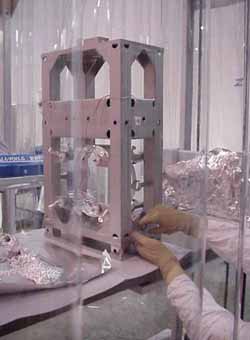
Figure 2: Cavity mirror for one of the LIGO interferometers is suspended by a single wire inside a metal cage. The mounting system is designed to insulate the mirror from as much thermal noise and vibration as possible. (Courtesy of LIGO Laboratory).
Project status
"We hope to have two interferometers working by the end of this year," says Rainer Weiss of MIT. At the Livingston facility, half of one arm has been evacuated and outgassed. The stainless steel tube was "baked" by applying a vacuum and heating the tube to nearly 170º C using two 5 kA power supplies connected across the beam tube. The tube's electrical resistance causes ohmic heating, which in turn causes water and other light volatiles absorbed on the inner surface of the beam tube to dissociate from the surface so they can be pumped out of the vacuum system. Two turbo pumps and eight cryo pumps along the beam tube continue to pump on the beam tube during bake out. After 18 days, the the outgassing rate for water vapor in the beam tube dropped from about 10-10 TL/cm2s down to 10-17 TL/cm2s.
Work is farther along at Hanford, where aligning the laser beams over kilometer-long distances proved to be quite a trick. In late November, the first beam was sent 2 km, halfway down the Y arm. There was no latitude for coarse adjustments: To avoid the possibility of injecting noise, the steering mirror controllers were designed with only enough range to steer the beam by less than 40 arcsec—"About the angle subtended by a pumpkin pie at a distance of a mile," says researcher Fred Raab.
Before the laser was turned on, engineers used ground and GPS surveys to locate the tubes and corner station building to within 0.5 in. over the miles-long campus. "Some fancy optical work was undertaken to derive directions from these [survey] marks and then place and align mirrors within the vacuum system to align the laser beam to the beam tube direction," says Raab.
When the beam was turned on, the beam footprint 2 km away was initially out of alignment by only about 25 cm vertically and 10 cm wide horizontally. The researchers have seen interference fringes from the world's largest resonant optical cavity, formed between the two 11-kg synthetic fused-silica mirrors. They maintained the fringes for as long as about half a minute, before losing resonance due to a problem in the laser stabilization.
LIGO II
First observations from LIGO are expected in 2002. Meanwhile, researchers are designing a more sensitive detector. Improvements in the lasers and optics will provide more sensitivity and enable yet more elusive science.
The limits of sensitivity of the LIGO come from the shot noise limit (the statistical fluctuation in the number of photons arriving at our photodetector makes us uncertain about the exact position of the test masses).
About the author…
Yvonne Carts-Powell is a freelance science writer based in Belmont, MA.