
Holoporting To And From Space: The Future Of Cosmic Communication

By John Oncea, Chief Editor, Clinical Tech Leader
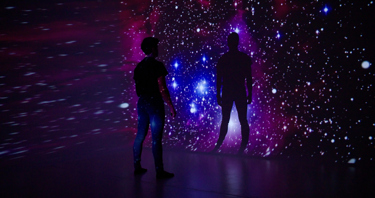
Holoportation technology enables real-time 3D communication between Earth and space, allowing medical professionals and others to virtually visit astronauts aboard the International Space Station while promising revolutionary applications for future Mars missions.
Imagine you’re Pablo Popovych, the first Ukrainian cosmonaut. It’s August 12, 1962, and you and fellow cosmonaut Andriyan Nikolayev are orbiting the Earth in Vostok 3 and 4, testing the ground control capability to launch and manage two separate, concurrent flights, among other things.
Unexpectedly, Soviet rocket engineer and spacecraft designer Serhiy Korolyov radios you with a special request: sing a song. Naturally, you respond with Watching the sky and thinking a thought, written by Ukrainian romantic poet Mykhailo Petrenko in 1841.
And with that, you’ve become the first person to transmit a song from space. Three years later, astronauts Wally Schirra and Thomas Stafford smuggled a harmonica and bells onto Gemini 6A and played Jingle Bells over the radio, creating the first live musical performance in space.
Over the next 60 years, out-of-this-world musical performances continued, from Alan Shepard and Ed Mitchell singing on the moon during the Apollo program, to Ronald McNair playing a saxophone on the Space Shuttle Challenger, to Chris Hadfield performing Space Oddity aboard the International Space Station.
On September 13, 2024, Polaris Dawn Mission Specialist Sarah Gillis took things to a different level. Not only did she perform John Williams’s Rey’s Theme on her custom-made violin while aboard the Dragon spacecraft, she was joined by youth musicians from around the world, all of them students in the international El Sistema network of organizations. Video of the historic performance is the first-of-its-kind downloaded from space via Starlink high-speed internet.
When Gillis performed Rey’s Theme with youth musicians around the world, she was in space, and they were on Earth. But what if the kids were in space, with Gillis? Maybe not in person, but say … as holograms?
For years a favorite trope of sci-fi authors, holograms and holoportation are becoming a critical step for future space exploration, with potential uses including private medical conferences, virtual visits, and detailed remote assistance for astronauts.
The Evolution Of Holograms: From Theory To Three Dimensions
The journey toward holoporting into space began in 1948 when Hungarian-British physicist Dennis Gabor invented holography while attempting to improve electron microscope resolution. Gabor created the term from Greek words meaning “whole” and “message,” though his early experiments used mercury arc lamps and could only produce flat, two-dimensional images after exposures lasting many hours.
The real breakthrough came with the 1960 invention of the laser, which provided the coherent light source necessary for creating true three-dimensional holograms. In 1962, researchers Emmett Leith and Juris Upatnieks at the University of Michigan produced the first laser transmission hologram, capturing a toy train and bird in stunning three-dimensional clarity. That same year, Soviet scientist Yuri Denisyuk developed reflection holography, creating holograms viewable in ordinary light. These pioneering efforts transformed holography from a theoretical concept to a practical technology.
By the late 1960s and early 1970s, holography continued to advance. Stephen Benton invented white light transmission holograms in 1968 at Polaroid Research Laboratories, making holograms accessible without specialized laser equipment. Gabor received the Nobel Prize in Physics in 1971 for his foundational work. From there, holographic technology found applications in security features on credit cards, scientific research, medical imaging, and entertainment, setting the stage for even more ambitious applications beyond Earth’s atmosphere.
Beaming Into Orbit: Holoportation Reaches The Space Station
In October 2021, NASA achieved a historic milestone when flight surgeon Dr. Josef Schmid and several colleagues became the first humans “holoported” from Earth to space. Using Microsoft HoloLens technology combined with custom software from Aexa Aerospace, Schmid appeared as a three-dimensional hologram aboard the International Space Station, where he conversed with European Space Agency astronaut Thomas Pesquet.
The technology works by capturing a person from multiple angles using specialized depth cameras. These recordings are processed to create high-quality three-dimensional models that are then compressed and transmitted in real time. When combined with mixed reality displays like HoloLens, this allows users to see, hear, and interact with remote participants in 3D as if they were physically present in the same space.
What makes this achievement particularly remarkable is that it works despite the space station traveling at 17,500 miles per hour in constant motion 250 miles above Earth. The holoportation system maintains stability, allowing astronauts to return to a holographic conversation minutes or even weeks later and find the projected person still present in that spot.
NASA envisions expanding holoportation’s role significantly. The agency plans to implement two-way communication, where people on Earth are holoported to space and astronauts are sent virtually back to Earth. Applications include private medical conferences, psychiatric consultations, family visits, and bringing VIP guests virtually aboard the station.
The next evolution involves combining holoportation with augmented reality for true tele-mentoring. Imagine an expert instructor or equipment designer appearing virtually beside an astronaut to provide hands-on guidance for complex repairs. This capability could prove invaluable for maintaining sophisticated systems in orbit, effectively placing the world’s best specialists at an astronaut’s side regardless of physical location.
Technical Challenges And Potential Solutions
Despite its promise, holoportation faces significant obstacles, particularly for deep space missions. The most pressing challenge is communication delay; signals between Earth and Mars take 5 to 20 minutes each way, even traveling at light speed, depending on the planets’ relative positions. This latency makes real-time interaction impossible and will present unique challenges whether through radio transmissions, video streams, or holoportation.
Another major hurdle involves the technology’s resource demands. Holoportation requires substantial bandwidth and computing power to transmit high-quality volumetric data in real time. Researchers have worked to address this: Microsoft reduced bandwidth requirements by 97 percent while maintaining quality, making mobile holoportation systems more practical. However, achieving photorealistic, full-body reconstruction at 30 frames per second remains challenging, with current systems reaching only 15 frames per second.
Multi-user scalability presents additional complications. Supporting multiple people in a holoportation session simultaneously demands solutions for managing latency, bandwidth, and processing capacity across different network conditions. Hardware limitations also restrict the achievement of high-resolution volumetric capture across various devices.
Some users experience cybersickness, symptoms similar to motion sickness caused by exposure to immersive virtual environments. The intensity varies based on exposure duration and the nature of the virtual content being displayed.
Cost remains a significant barrier to widespread adoption. Current holoportation systems require expensive, high-end equipment, though prices continue declining as technology advances. Microsoft’s Mesh platform aims to make mixed reality development more accessible by handling complex technical challenges, allowing developers to create applications without requiring users to possess sophisticated equipment.
For Mars missions, strategies to work around communication delays will be essential. Pre-recorded holoportation sessions, asyncronous communication methods, and increased astronaut autonomy may help bridge the gap when real-time interaction proves impossible. Despite these challenges, the technology’s successful deployment aboard the ISS demonstrates its viability for space applications.
The Road Ahead: Transforming Space Exploration And Beyond
The future of holoportation in space appears extraordinarily promising. As NASA develops plans for crewed Mars missions – expeditions expected to last three years – holoportation could prove crucial for maintaining astronaut mental health and operational effectiveness. The technology offers vital opportunities for staying connected with Earth and Mission Control, whether for medical support, mission assistance, or family contact.
The emotional benefits cannot be overstated. Long-duration spaceflight creates profound psychological stress from isolation and separation from loved ones. Holoportation provides more personal, engaging contact than traditional video calls, helping astronauts feel truly present with family members despite vast distances. For Mars-bound crews especially, this enhanced connection could significantly impact morale and mission success.
Beyond emotional support, holoportation promises practical advantages for complex operations. Combining the technology with haptic feedback could enable collaborative repair work, allowing Earth-based specialists and astronauts to virtually work together on critical hardware. This capability effectively extends Earth’s expertise throughout the solar system, ensuring missions have access to the best minds regardless of physical location.
Applications extend far beyond space exploration. In extreme terrestrial environments – Antarctic research stations, offshore oil platforms, remote military bases – holoportation could provide similarly valuable communication capabilities. The technology shows particular promise for healthcare, enabling specialists to virtually visit patients in rural or underserved areas. Educational institutions could bring world-class instructors to students anywhere, creating truly immersive learning experiences.
The commercial sector also has recognized holoportation’s potential. Companies continue developing more affordable, accessible systems that could revolutionize remote work, entertainment, and social interaction. As costs decrease and technology improves, holoportation may become as commonplace as video calling is today.
Recent demonstrations have highlighted the technology’s maturation. Events around the world have featured government officials and industry leaders holoported across continents, displaying the systems’ reliability and expanding applications. These successes validate the years of research and development while pointing toward a future where physical presence becomes optional for many human interactions.
Perhaps most exciting is holoportation’s potential to redefine what’s possible in space exploration. By enabling Earth’s collective knowledge and expertise to virtually accompany astronauts to Mars and beyond, the technology could accelerate scientific discovery, improve mission safety, and help humanity establish a sustained presence throughout the solar system. What once existed only in science fiction, the ability to project human presence across cosmic distances, is rapidly becoming reality, opening new frontiers in how we explore, work, and connect across the final frontier.