
DBR diode laser pumps continuous wave OPO
Editor's Report
Coherent emission sources just keep getting more compact, robust, and simple to use. Diode-pumped solid state laser excitation sources were the first step in shrinking system sizes, followed by the use of external cavity diode lasers for pump sources. Now Angus Henderson and colleagues at <%=company%> (Bothell, WA) have used a distributed Bragg reflector (DBR) diode laser to directly pump an optical parametric oscillator (OPO), generating up to 18 mW of output at mid-infrared wavelengths (see Figure 1).1
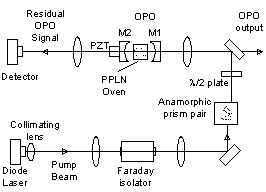
"You need a very stable single frequency pump source," said Henderson. Typically, diode lasers don't reliably run on a single frequency, but tend to mode hop. Although external cavity lasers are significantly less prone to mode-hopping, the price of that control is dealing with discrete components. "You need precise mechanical control over the [external cavity diode lasers]," said Henderson. "DBR lasers have no external mechanical components. It's possible to continuously tune the frequency of that single longitudinal mode by varying diode current—no moving parts, no etalon." Henderson went on to note that they perform OPO tuning via an electronic servo-system that tracks the diode frequency variation. "All tuning is done electronically," he summarized.
System design
Working with periodically-poled lithium niobate (PPLN), the group built a discrete cavity, doubly resonant OPO. For the pump source, they used a then-commercially-available 150 mW DBR diode laser (SDL Inc.; San Jose, CA) operating at 852 nm. The PPLN poling period was chosen to be around 23 µm, permitting operation at a temperature above that at which photorefractive problems occur. The OPO system has demonstrated mode-hop-free operation for as much as 90 min.
For coarse tuning (on the order of 100 nm), the team temperature tunes the PPLN, using ceramic heaters that provide temperature control with 5 mK stability. Temperature tuning eliminates the need for changing the refractive index or phase matching point of the PPLN by changing the angle of the crystal.
For fine continuous tuning (up to 200 pm at 2.3µm wavelength) of the OPO signal or idler wavelength, the group adjusts the diode drive current and hence the diode wavelength, while a piezoelectric servo system maintains OPO cavity length to avoid OPO mode-hops.
Using three different mirror/PPLN coating sets, the group was able to achieve signal wavelengths ranging from 1.1. to 1.4 µm, and idler wavelengths ranging from 2.2 to 3.7 µm. The system displayed an amplitude stability of better than 0.2% over a 30 min. period.
Future work
According to Henderson, the team is working to scale up output power by increasing the pump power. Given that the system is uncooled, sufficient power would make it potentially attractive for atmospheric and other remote sensing applications. "If you do the appropriate engineering on the system, I don't see any reason why not," said Henderson. Typical sources for these applications include lead salt or quantum cascade lasers, both of which are liquid nitrogen cooled. In contrast, the DBR-laser-pumped OPO provides a mid infrared source that requires no cooling.
The progress in field has been amazing, says Henderson. "Seven years ago we were doing ground-breaking work with single frequency argon laser," he said. "Now the same thing is achieved using a diode laser in a TOC can with sub-amp level current. It's a major step forward in terms of making practical systems."
References
1. A. Henderson, P. Roper, et. al., "Stable, continuously tunable CW OPO pumped by a DBR diode laser, with idler output from 2.2 to 3.7 µm," Conference on Lasers and Electro-Optics (CLEO 2000) postdeadline paper #CPD10, San Francisco, CA (2000).
By: Kristin Lewotsky, Photonics Online