
Fluorescent materials to revolutionize the flat panel display industry
By Phillip B. Espinasse
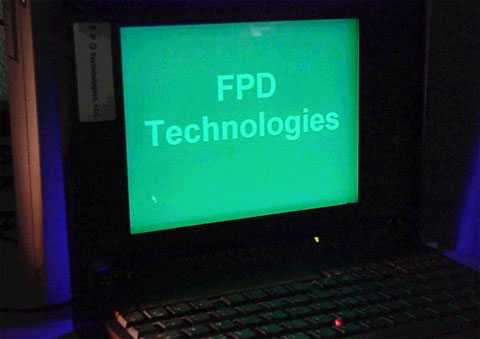
Using an IBM laptop, Inventor Edward Pope of FPD Technologies (Westlake village, CA) demonstrated a fluorescent liquid crystal display (FLCD) for a laptop computer, combining fluorescent materials with conventional liquid crystal display technology (see figure 1). After coating the front of the fully functional computer screen with a fluorescent material, Pope substituted the conventional white backlight for a precision single wavelength blue light source to illuminate the laptop's liquid crystal display (LCD). The light passes through the LCD system to strike the phosphor layer, emitting a green wavelength to generate a monochromatic display. This new technology overcomes two major disadvantages of conventional LCD screens: viewing-angle limitations and energy consumption.
Although this particular prototype is essential in validating the working concept of FLCD technology, future manufacturing-friendly models will substitute the color glass filters found in conventional LCDs for the fluorescent material. The material will be applied to the inside surface of the glass facing the viewer, with a polarizer layer and common electrode gate array on top of it. To provide a more compact solution, a single wavelength light-emitting diode (LED) will be used as a light source.
In the near term, explains Pope, the monochrome version will find applications in a number of areas such as medical equipment, avionics and instrumentation in general. Also, cell phones and portable type devices requiring LCDs stand to benefit from the improved images, reduced power consumptions and costs associated with FLCD technology.
Conventional LCD technology vs. FLCD technology
In conventional LCDs, a backlight shines a multi-wavelength light onto a LCD wedged between two polarizers. The LCD basically functions as a spatial light modulator, selectively passing illumination from the backlight through to the screen. A gate electrode array in the back of the LCD controls which pixels are transparent (illuminated) and which are not.
The sandwiched LCD is capped by a glass color filter that transmits only the desired wavelength and focuses the source light. Back-reflections of the non-transmitted wavelengths and the highly directional nature of the emitted light result in high power dissipation and poor viewing at wide angles, respectively. Also, due to the stringent alignment requirements of glass filters to each pixel, manufacturing of present LCD systems is quite costly. FLCD technology solves these problems and is, stresses Pope, twice as efficient as conventional LCD technology:
In the experiment, Pope used a 470-nm, 15-W "VisiBlue" transilluminator as a backlight source (UV Products; Upland, CA). The phosphor layer, an inorganic material, is deposited onto the 10.1 in. diagonal (600 800 pixel) computer screen using a solution-based method.
According to Pope, one can tune the emission wavelength simply by varying the composition of the fluorescent material. The materials tend to emit light isotropically and omnidirectionally, hence promoting outstanding quality viewing at all angles and brighter images at higher resolutions. The FPD Technologies group is keen on the idea of printing stripes of phosphor materials onto sheets of glass using an "Inkjet" type approach, which will reduce manufacturing costs dramatically.
Future Work
Aside from optimizing this monochrome version of FLCD technology for optimum picture sharpness, brightness and compactness, the FPD group is currently pursuing ways to "print" the gate electrode array pattern and the fluorescent stripes in a one step process. Of course, the ultimate goal is to develop a color FLCD system. The team envisions producing the green and red color by fluorescence, while capturing the blue color simply by diffusing the incoming source light.
Intellectual property
1. U.S. Patent # 5,480,582, "Process for Synthesizing Amorphous Silica Microspheres with Fluorescence Behavior." Issued Jan. 2, 1996.
2. U.S. Patent # 5,757,124, "Display Screen Having Amorphous Silica Microspheres with Fluorescence Behavior." Issued May 26, 1998.
3. U.S. Patent pending, "Photoluminescent / Electroluminescent Display Screen." Filed May 20, 1998. Int'l PCT filed May 19, 1999.
4. U.S. Patent #5,602,445, "Blue-Violet Phosphor for Use in Electroluminescent Flat Panel Displays." Issued Feb. 11, 1997 to Oregon Graduate Institute. Exclusive world wide rights licensed to FPD, 1998
About the author
Phillip Espinasse is a technology freelancer for Photonics Online, based in Bloomington, MN. He is currently involved in the research and development of RF c-BiCMOS processes.