
New smart material paves way for ultralight deployable space mirrors
By: Phillip Espinasse
Using a computer-controlled electron gun to fire electrons onto polyvinylidene fluoride (PVDF), a piezoelectric bimorph material, Tammy Henson and researchers from Sandia National Laboratories (Albuquerque, NM) in collaboration with University of Kentucky (Lexington, KY) have reshaped the thin film structure to a desired optical prescription (see Figure 1).
The work is of great interest to the space community, effectively providing NASA with new options for next generation telescopes and high-end surveillance systems applications. The piezoelectric mirrors are ultralight (less than 1 kg/2) compared to the Hubble telescope's solid glass mirror (250 kg/m2). They open the possibility for improved cost-efficiency by reducing payload weight, while providing larger apertures and consequently improved resolution. Theoretically, these thin films could be folded for launch, deployed on orbit and shaped with the electron gun.
Flexible mirror & shape control concept
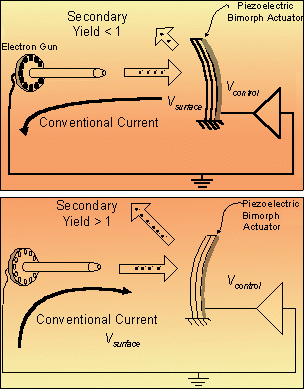
The underlying principle of the work is that piezoelectric materials change shape when subjected to a voltage. John Main and the University of Kentucky research team made their PVDF mirror from a two-layer bimorph, fabricated from 52-µm sheets. The front side of the bimorph mirror is coated with an optical grade nickel-copper electrode, and a layer of epoxy glue connects both piezoelectric layers.
After selecting a bias current on the electrode of the mirror, Main used an electron-gun to shape the material by controlling the secondary electron yield so that either a net negative charge or a net positive charge was added to the bimorph mirror's other side (see figure at top). The electron-gun's charge application effectively closes the current loop so that the bimorph sandwich functions as an actuator, reshaping the mirror to a concave or convex optical prescription.
Feedback control system
To obtain the desired shape with optical-quality precision, the researchers developed a feedback control system. They first used interferometric and laser displacement sensors to determine the initial mirror surface profile. From this information, computer generated shape control algorithms provide the electron-gun with the proper excitation profiles to adjust the mirror to its desired shape (see Figure 2).
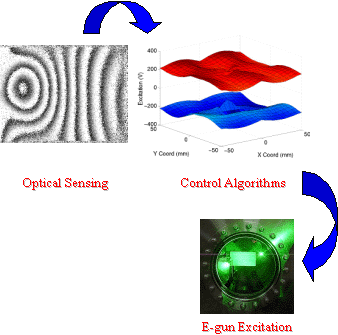
The team implemented a 1-D control algorithm for a 20 ´ 4 ´0.06 cm cantilevered PZT5A bimorph, attaining the desired shape correction to a curvature of 0.001 cm-1. The group has also developed a 2-D shape control algorithm and approach; however, both top and bottom surfaces need to be independently excited to satisfy the distributed 2-D curvature control.
Future developments
While PVDF was selected because it is inexpensive, readily available and exhibits the necessary properties, researchers are currently investigating piezoelectric polyimide thin film material due to its better tolerance of space environment. To be suitable for imaging systems operating at visible wavelengths, these bimorph mirrors will need to be corrected to the desired shape to within less than 100 nm, says Tammy Henson of the Sandia group. Ongoing research on mirror figure sensing, electron gun excitation and control algorithms is currently underway. Work is being pursued on these 3 key elements in order to make non-contact shape control of large deployed optics a viable solution for near future space applications.
References
1. J. M. Redmond, P. S. Barney, et. al., "Distributed sensing and shape control of piezoelectric bimorph mirrors," ASME International Mechanical Engineering Congress and Exposition, November 18, 1999.
2. J.W. Martin, J.A. Main, et. al., "Shape control of deployable membrane mirrors," Proceedings of the 1998 ASME International Mechanical Engineering Congress and Exposition, Anaheim, CA, November 15-20, 1998.
About the author
Phillip Espinasse is a technology freelancer based in Minnesota. He is currently involved in the research and development of RF c-BiCMOS processes.