
Photonics West '00: Nano-Structuring Tunes IR Emitters
By: Yvonne Carts-Powell
Infrared emitters with unusually narrow spectral bandwidths can be tailored by surface processing, reported researchers from <%=company%> (Waltham, MA) and NASA's Jet Propulsion Laboratories (Pasadena, CA) at Photonics West (San Jose, CA; January 22-28). Such infrared emitters show promise for IR light sources in mass-market gas sensing systems.
Ion Optics president Edward Johnson described how the IR emitters were developed from the company's current silicon IR radiators, under both an SBIR grant from the National Science Foundation and an ATP contract from the National Institute of Standards and Technology.
Thermal emission from heated materials follows the blackbody curve, multiplied by emissivity. Jim Daly and other researchers at Ion Optics and JPL have learned how to manipulate the emissivity of a material at different wavelengths, thus changing it's radiative spectrum.
How it works
The metal filaments in the commercially available radiators have a random surface structure (see Figure 1). This structuring increases the device's emissivity at wavelengths that are short compared to the feature sizes on the surface, but leaves the emissivity low at wavelengths longer that the feature sizes. The emission spectrum of the radiator can be manipulated away from standard blackbody radiation, suppressing long-wavelength radiation, by controlling the surface feature sizes and depths.
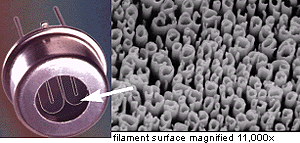
Compared to conventional sources for non-dispersive IR spectroscopy—tungsten lamps or Nernst globars—these radiators give more output in-band, at the measurement wavelength, while creating less out-of-band noise. The resulting emission band, however, is fairly broad (the linewidth divided by the wavelength is about 0.5), certainly broader than that from IR LEDs.
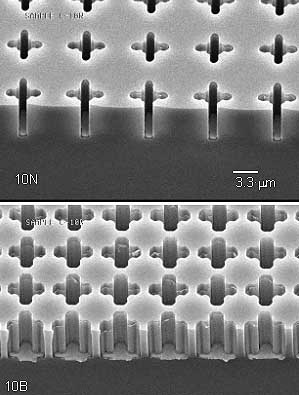
But what if the patterning was not random? The researchers used lithography to pattern crosses of varying sizes onto a silicon wafer and measured the reflectance and radiative spectra for different feature sizes and depths (see Figure 2). As the figure shows, they also coated the wafer with metal to suppress the background emissivity, which enhances the contrast between peak emission and background emission.
Periodic structures
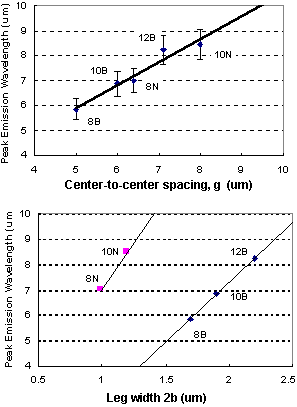
The repetitive patterns of the devices somewhat resemble photonic bandgap structures. Daly and his coworkers found that the surface feature dimensions are directly related to the emission spectra. Specifically, the peak emission wavelength is linearly related to feature size and the linewidth correlates with feature size and spacing (see Figure 3). Increasing the depth of the features broadens the long wavelength side of the emission peak. The FWHM linewidth divided by the wavelength (D l/l) can be narrowed to about 0.1, which is comparable to the linewidth from IR LEDs.
The patterned radiators also have the advantage over IR LEDs of providing more output: hundreds of milliwatts of in-band power, compared to tens of microwatts from an LED. These light sources reduce power requirements for applications now using broadband sources with filters, and in some cases entirely eliminate the need for filters.
The company says it can design and manufacture low cost higher power tuned band emitters at any specific wavelength in the IR range (2 to 20 µm), and expects to offer these devices to non-dispersive infrared (NDIR) gas and chemical sensor manufacturers. The devices could allow sensors with higher sensitivity, because the power in-band is higher and the power out of band is lower, thus providing less noise.
Applications
Gas sensing applications involve air quality monitoring, and combustion emissions monitoring. One interesting possibility for commercialization lies in sensing carbon monoxide (CO) or carbon dioxide (CO2).
Home carbon monoxide sensors have been available since 1993. There are roughly 20 million CO monitors, mostly operating on electrochemical or catalytic principles. The false alarm and false-negative rates of the sensors, however, are high. According to the researchers, "An inexpensive NDIR CO sensor could be a viable alternative to these if it were sensitive enough and immune to interference, especially from carbon dioxide."
To distinguish the absorption peak of CO at 4.65 µm from the stronger absorption peak of CO2 at 4.26 µm, a sensor would need an emitter with a FWHM linewidth close to the linewidth of the gas absorption peaks, or in other words, D l/l < 0.1. By narrowing the linewidth, not only is the sensor able to distinguish smaller changes in the CO concentration in the air, but it also becomes less sensitive to CO2 concentration changes.
References
J.T. Daly, A.C. Greenwald, et. al., "Nanostructured surfaces for tuned infrared emission for spectroscopic applications," Paper #3937-14, Photonics West '00, San Jose, CA (2000).
About the author...
Yvonne Carts-Powell is a freelance science and technology writer based in Belmont, MA.