
'Rainbow' Lasers Light Up The Future
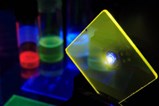

University scientists have created the next generation of low cost light sources — lasers which can be tuned to every color of the rainbow.
The new technology developed by physicists at the University of St Andrews can be used for a wide range of applications, from medical treatment to light-emitting clothing. Because of their ability to be powered by a simple light-emitting diode (LED) rather than another laser, the compact new visible lasers can be created at a fraction of the cost of existing technologies.
The breakthrough by physicists Professor Ifor Samuel and Dr Graham Turnbull uses remarkable plastic-like semiconducting materials. These flexible light-emitting materials combine the virtues of semiconductors with the simple manufacture of plastics, and have even been used to make a light-emitting sticking plaster for the treatment of skin cancer. The new technology provides simple, compact lasers which could revolutionize point of care diagnosis and treatment.
Professor Samuel said, “For over forty years visible organic lasers have required another laser to make them shine. We have now developed a low-cost, easy to make plastic laser, which converts the light from an LED (of the kind used in torches and traffic lights) into laser light. LEDs can be battery powered, and so this hybrid LED-laser approach can make very simple compact emitters. The lasers can give a variety of colours and are suitable for various applications such as spectroscopy or chemical sensing.”
With a range of colors across the visible spectrum, the LED-lasers could be used for displays, Christmas lights, or even light-up trainers.
Collaborator Dr Graham Turnbull said, “The new lasers are incredibly cheap and disposable and so could be used in single-use medical diagnostics, or in extreme environments such as sensing for explosives. Conventional visible lasers can cost anything between a few hundred pounds to tens of thousands, but our new laser can be created for less than five pounds. These LED-lasers offer a better, smaller and brighter alternative to conventional light sources. They are the next generation of low cost lasers.”
SOURCE: University of St Andrews